The 20p tyre tread test is a quick home check that uses a 20 pence coin to show whether a tyre may be below the UK legal minimum tread depth of 1.6mm. It offers a simple visual guide, but it does not replace a proper tread depth gauge or a full tyre inspection.
This guide explains how to do the test correctly, what the result means, and when to measure tread more accurately or replace the tyre.
Key takeaways
- Place a 20p coin in the main tread grooves and check the outer band stays hidden.
- The 20p test gives a quick visual check at about 3mm, above the 1.6mm legal minimum.
- Check several points around each tyre because tread can wear unevenly across width and circumference.
- Measure in the central three-quarters of the tread, near inner, centre and outer grooves.
- Clean out stones, mud and dirt first so the coin reaches the true base.
- Use a tread depth gauge if the result looks close or any band remains visible.
- Replace the tyre if any area drops below 1.6mm or damage exposes deeper layers.
How the 20p tyre tread test works and what it shows
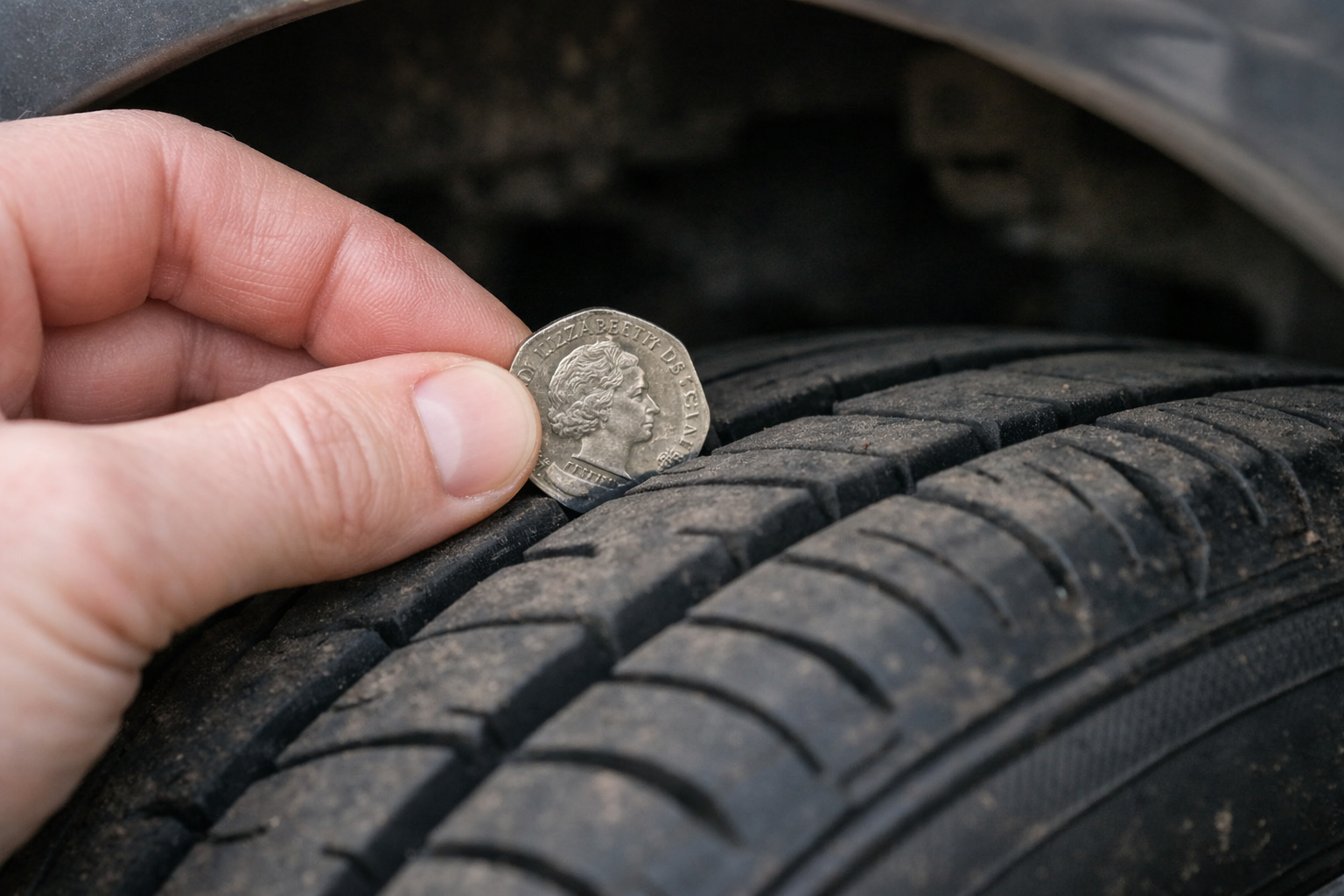
Place a 20p coin into the main tread grooves on each tyre and check whether the outer band stays hidden. It measures about 3mm, so it gives a quick visual check above the UK legal minimum of 1.6mm.
If the outer band is visible, tread depth may be low and the tyre needs a proper check with a tread depth gauge. Test several points around the tyre because wear can be uneven across the width and circumference.
The coin test helps spot tyres close to replacement, but it does not confirm full safety. Cuts, bulges, cracking and tyre age can still make a tyre unroadworthy even when tread looks acceptable.
Use the 20p check as a regular home screening step, then confirm doubtful results with a gauge or professional inspection. This is especially useful before long trips, motorway driving or wet-weather travel, when low tread has the biggest effect on grip and braking.
How to check tyre tread depth at home with a 20p coin
A full check takes under two minutes per tyre and gives clearer results when you follow the same routine on every wheel. Turn the front tyres slightly for easier access, then place a 20p coin into several main grooves across the central three-quarters of the tread. Move the car if needed to inspect more of the tyre.
This method works well at home because it is quick, free and easy to repeat. It can reveal uneven wear that a single check may miss, especially from tracking, inflation or suspension problems. If any part of the coin’s outer band shows, confirm the depth with a tread gauge or ask a tyre fitter to measure it.
A tread depth gauge gives a more exact reading, so use one for precise measurement or to track wear over time. A professional inspection makes sense if the tread looks close to the limit, the wear is irregular, or the tyre has cuts, bulges or exposed cords. For the UK legal standard, check GOV.UK and TyreSafe.
Where to measure tread across each tyre for an accurate result
Checking only the most visible groove can miss worn areas, especially when tread has worn unevenly across the tyre. Measure in the main circumferential grooves across the central three-quarters of the tread, because that is the part covered by the UK legal requirement.
Take readings near the inner shoulder, through the centre, and near the outer shoulder, but avoid the very edge where the tread meets the sidewall. The raised bars moulded into the grooves are tread wear indicators. When the surrounding tread sits close to those bars, depth is approaching the legal limit of 1.6mm set out by the GOV.UK vehicle safety guidance.
This spread of checks shows whether the tyre is wearing evenly. More wear in the centre often points to over-inflation, while heavier wear on both shoulders can indicate under-inflation. If one side is lower than the other, wheel alignment or suspension faults may need attention, not just a tyre replacement.
UK legal tyre tread limits and when a tyre needs replacing
- It is quick, free and easy to repeat at home.
- It gives a visual check against tread getting close to replacement.
- It can help spot uneven wear when used at several points.
- It does not confirm the legal minimum of 1.6mm precisely.
- It can miss problems if you only check one groove or one area.
- It does not assess cuts, bulges, cracking, exposed cords or tyre age.
The UK legal minimum is 1.6mm of tread across the central three-quarters of the tyre around its full circumference. If any part falls below that, the tyre is illegal and needs replacing.
Check with a tread depth gauge if the 20p test looks close. Replace the tyre if the gauge shows under 1.6mm at any point, or sooner if wear bars are nearly level, the rubber is cracked, or cuts expose deeper layers.
Do not judge a tyre by one groove or a quick glance. It can look fine at the outer edge and still be illegal elsewhere, especially with uneven wear from alignment, pressure or suspension faults. If one tyre wears faster than expected, check inflation and review related details such as the tyre load index before fitting a replacement.
Do not wait for the exact legal limit. Wet-weather grip drops as tread gets low, and replacing at around 3mm gives a better safety margin in heavy rain.
Common mistakes that can make the 20p tread test misleading
Accurate results improve when the tread is dry, visible and checked on level ground. Dirt, small stones and packed mud can hide the groove depth and make the coin sit higher than it should. Before testing, remove debris from the main grooves and clean your tyres so the coin reaches the true base of the tread.
Tyre position can mislead the check as well. A turned wheel may expose one area clearly while hiding wear on the inner edge, where problems often develop first. Poor light also makes the outer band harder to judge, so inspect in daylight or use a torch and check the full circumference, not just the section nearest the valve.
Tyre damage can confuse the result even when tread depth looks acceptable. Cuts, bulges, cracking and feathered wear point to issues that a 20p coin cannot measure. If the tread looks close to the band, or the wear pattern seems uneven, confirm the depth with a gauge and arrange a professional inspection.
Frequently Asked Questions
How does the 20p tyre tread test work?
Place a 20p coin into your tyre’s main tread grooves. If the outer band of the coin is hidden, the tread is above the legal minimum; if you can see the band, the tyre may be too worn. Check several points across the tyre, as wear is not always even.
What tread depth should a tyre have to pass the 20p test?
The 20p test is only a quick check, not a precise measurement. If the outer band of the 20p coin stays hidden when placed in the main tread grooves, the tread is likely above 3mm. UK legal minimum tread depth is 1.6mm across the central three-quarters of the tyre.
Is the 20p tyre tread test accurate enough to replace a tread depth gauge?
Use a tread depth gauge for the most reliable reading. The 20p test is a quick home check that helps spot tyres close to the legal limit, but it only gives a rough indication. A gauge measures depth in millimetres, so it is better for accuracy and for checking several points across each tyre.
Should tyre tread depth be checked across the full width of the tyre?
Yes. Measure tread depth across the inner, centre and outer sections, not just one spot. Uneven wear can leave one edge below the legal limit even when the middle still looks acceptable.
What should you do if your tyre fails the 20p tread test?
UK law requires at least 1.6mm of tread across the central three-quarters of the tyre. If the outer band of the 20p coin stays visible, the tread may be too low. Replace the tyre as soon as possible and avoid long or high-speed journeys until it is checked by a tyre fitter.